Grow LED with Integrated Driver vs. External Driver: A Technical Analysis of Differences in Performance and Stability
In indoor cultivation LED lighting systems, the driver architecture is one of the most critical factors determining the equipment's actual performance. Beyond the nominal power (W) or theoretical efficiency (PPE), how the electrical conversion is managed directly impacts thermal stability, chip degradation, system reliability, and medium-to-long-term maintenance.
Often, attention is focused on power or efficiency, when the type of driver used can have a massive influence on the actual yield over years of operation.
In this article, we technically analyze the differences between the Integrated Driver and External Driver, two configurations present in the professional LED horticulture market.
What exactly is a grow LED driver?
The driver is the system responsible for converting alternating current from the mains (AC) into stable direct current (DC), tailored to the needs of the LED diodes.
We can consider it the "electrical heart" of the lighting system. Its function directly influences aspects such as:
- Intensity and voltage regulation.
- Electrical stability of the system.
- Protection against voltage spikes.
- Overall energy efficiency.
- Operating temperature control.
💡 A quality driver helps the diodes work within their optimal parameters, reducing electrical and thermal stress that can accelerate system degradation.
A quality driver helps the diodes work within their optimal parameters, reducing electrical and thermal stress that can accelerate system degradation.
Integrated Driver Architecture
In systems with an Integrated Driver, the power supply is built directly into the body of the panel or the LED bars. This design allows for more compact equipment and simplifies installation.
Main features
- All-in-one design.
- Less external wiring.
- Simple installation.
- Smaller total equipment volume.
- Generally lower manufacturing costs.
At first glance, it may seem like a very efficient solution for growers looking for simplicity and a quick setup.
External Driver Architecture
In systems with an External Driver, the power supply is physically separated from the light-emitting body. This is a common configuration in equipment geared toward professional cultivation, where stability and thermal management are top priorities.
Main features
- Driver independent of the LED system.
- Lower thermal load on the bars.
- Industrial-specification electrical components.
- Greater modularity.
- Simplified maintenance.
Although this type of design usually involves a slightly higher manufacturing cost, it offers significant advantages under certain growing conditions.
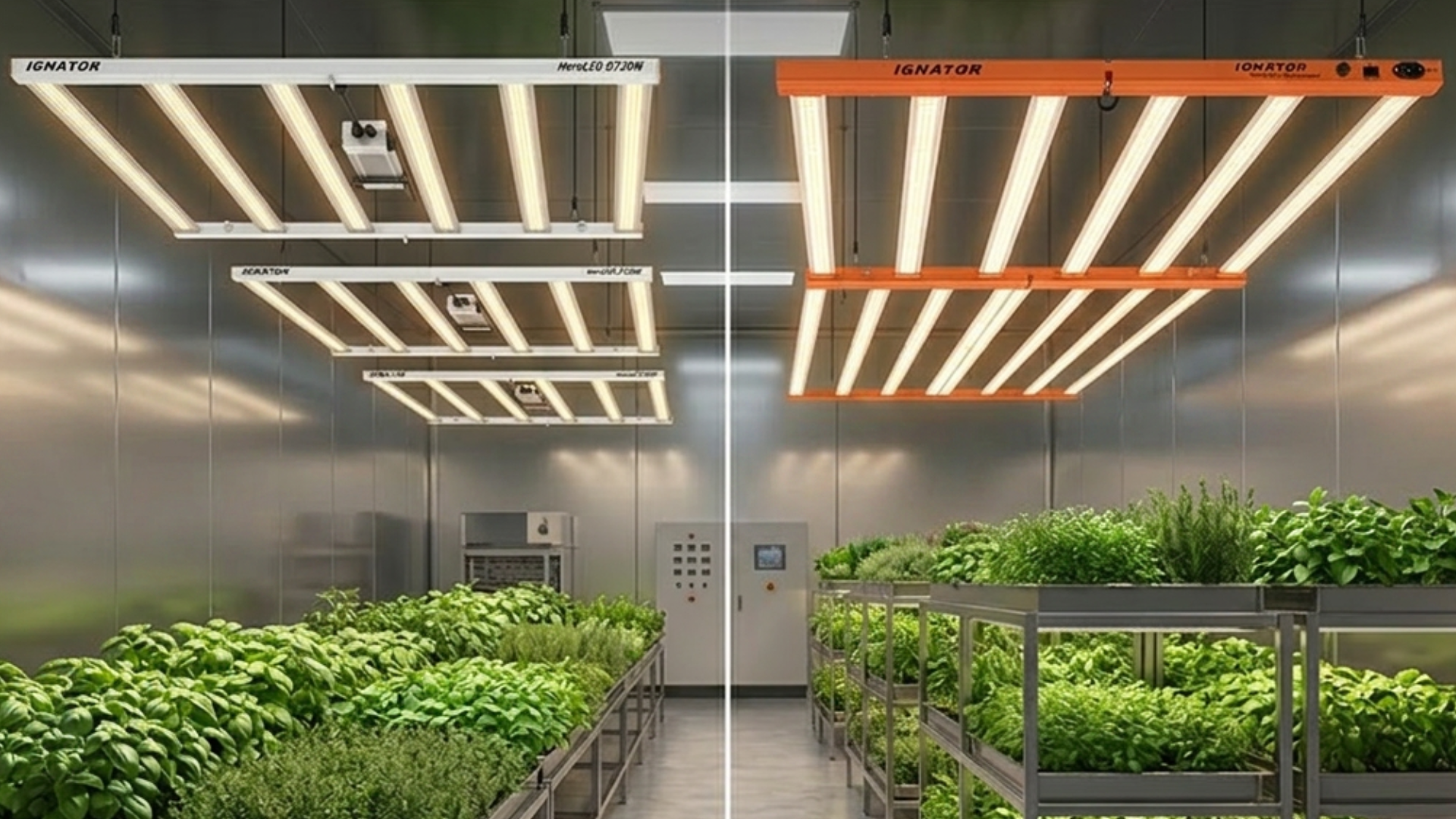
Technical comparison: Integrated Driver vs. External Driver
1. Thermal management and operating temperature
Temperature is one of the most important factors for the lifespan of any LED system.
-
In a system with an Integrated Driver:
- The heat generated by the driver adds to the heat produced by the LED chips.
- The overall temperature of the structure increases.
- The electronic components operate in a more demanding thermal environment.
-
On the other hand, in a system with an External Driver:
- The power supply is separated from the LED bars.
- The heat generated by the driver dissipates away from the lighting area.
- The diodes operate under more favorable conditions.
This difference is particularly relevant in crops where the equipment remains turned on for many hours a day.
2. Long-term LED chip degradation
All LEDs lose performance over time. However, the speed at which this degradation occurs largely depends on the operating temperature.
When chips constantly work at elevated temperatures:
- The progressive loss of light intensity is accelerated.
- The emitted spectrum may be slightly altered.
- The effective lifespan of the system is reduced.
For this reason, thermal control is one of the most important aspects of professional fixture design.
3. Real system efficiency
When comparing LED equipment, it is common to look only at the PPE value advertised by the manufacturer. However, the real efficiency also depends on the thermal working conditions.
A system with better heat management usually features:
- Lower energy losses.
- Greater operational stability.
- Better utilization of the energy consumed.
Therefore, two fixtures with similar specifications may perform differently after thousands of hours of use.
4. Quality and electronic architecture of the driver
Another rarely discussed aspect is the internal construction of the power system itself. Many fixtures with an Integrated Driver rely on multiple compact electronic modules distributed inside the luminaire.
Conversely, systems with an External Driver usually use larger, industrial-specification power supplies. Their advantages include:
- Better electrical filtering.
- Higher current stability.
- Lower sensitivity to grid fluctuations.
- Better performance against electrical spikes.
In professional facilities where a disruption can affect an entire production, this aspect takes on considerable importance.
5. Maintenance and technical service
Ease of maintenance is another point where significant differences appear.
- Integrated Driver: Repair usually requires working directly on the LED assembly, which can complicate access to the electronic components.
- External Driver: The driver can be replaced, serviced, or sent to technical support independently.
This offers several advantages:
- Less downtime.
- Easier diagnosis.
- Lower complexity during intervention.
- Reduced transport-related costs.
Although current failure rates are very low, ease of maintenance remains a crucial factor in professional setups.
6. Weight distribution and mechanical structure
The location of the driver also affects the physical structure of the equipment. By moving the weight of the power supply away from the LED bars:
- The load on the main structure is reduced.
- Handling the equipment becomes easier.
- Mechanical stress on the mounts is minimized.
This is a particularly interesting advantage in high-power luminaires intended for large growing areas.
7. Scalability in professional facilities
The advantages of the External Driver become even more evident in commercial facilities or large-scale projects. Its design facilitates:
- Quick replacements.
- Integration into advanced control systems.
- More efficient preventive maintenance.
- Simplified spare parts management.
For this reason, many professional growers consider this configuration uniquely suited for projects where operational continuity is a priority.
Example applied to IGNATOR equipment
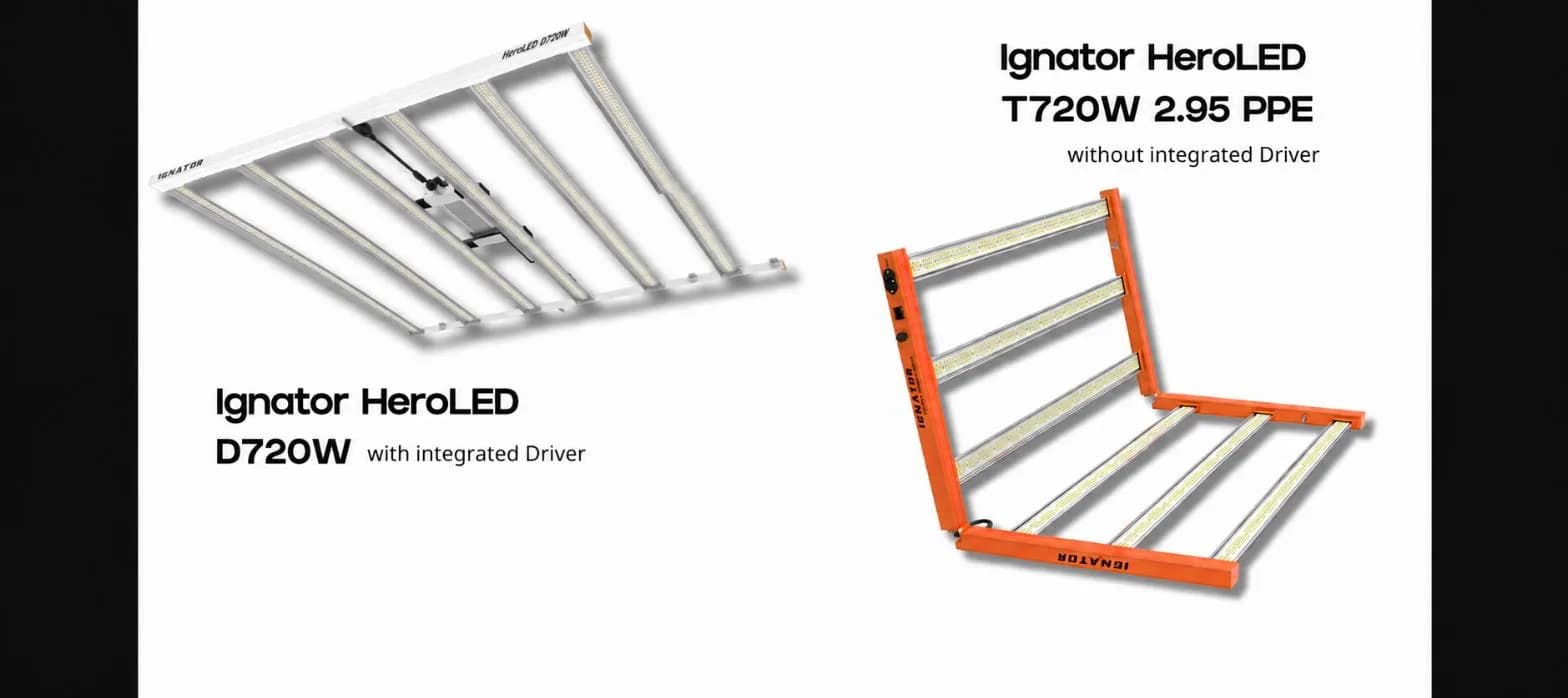
Within the IGNATOR catalog, we find examples of both design philosophies.
- On one hand, the IGNATOR HeroLed T720W 2.95 PPE opts for an Integrated Driver architecture, offering a compact, efficient, and easy-to-install solution.
- On the other hand, the IGNATOR LED D720W incorporates an External Driver system, aimed at maximizing thermal management, modularity, and operating stability under intensive use conditions.
Both fixtures have been developed to meet different needs within professional indoor cultivation.