PPFD and LED Efficiency: Why Some Crops Yield Much More While Using Less Light
PPFD and LED Efficiency: Why Some Crops Yield Much More While Using Less Light
A few years ago, most indoor growers chose a lighting fixture based solely on wattage. The more "powerful" the light bulb seemed, the better. For a long time, it was believed that increasing wattage was the fastest way to boost yields.
However, indoor cultivation has evolved immensely in recent years. Experience has shown that more power does not always equal more yield. In fact, two fixtures with identical power consumption can deliver completely different results. One can produce dense, compact, and homogeneous flowers, while the other generates stretched plants, excessive heat, and a highly irregular harvest.
The difference lies not just in the power itself, but in something much more critical: how the light is distributed and how much usable light actually reaches the plants.
This is where two key concepts of any modern LED cultivation setup come into play: PPFD and luminous efficiency. Understanding them can have a greater impact on a crop than simply adding more watts.
Plants Don't Use Watts; They Use Usable Light
Plants do not "consume" watts. Watts only indicate how much electricity a light fixture uses, but they do not reflect how much usable light actually reaches the crop.
Because of this, more and more growers are shifting their focus away from raw wattage and paying attention to more important aspects, such as:
- The PPFD delivered by the equipment.
- The way the fixture distributes light.
- Its real efficiency.
In other words, the focus is no longer on how much energy a fixture consumes, but rather on how much light output it is capable of generating.
What Is PPFD and Why Is It So Important?
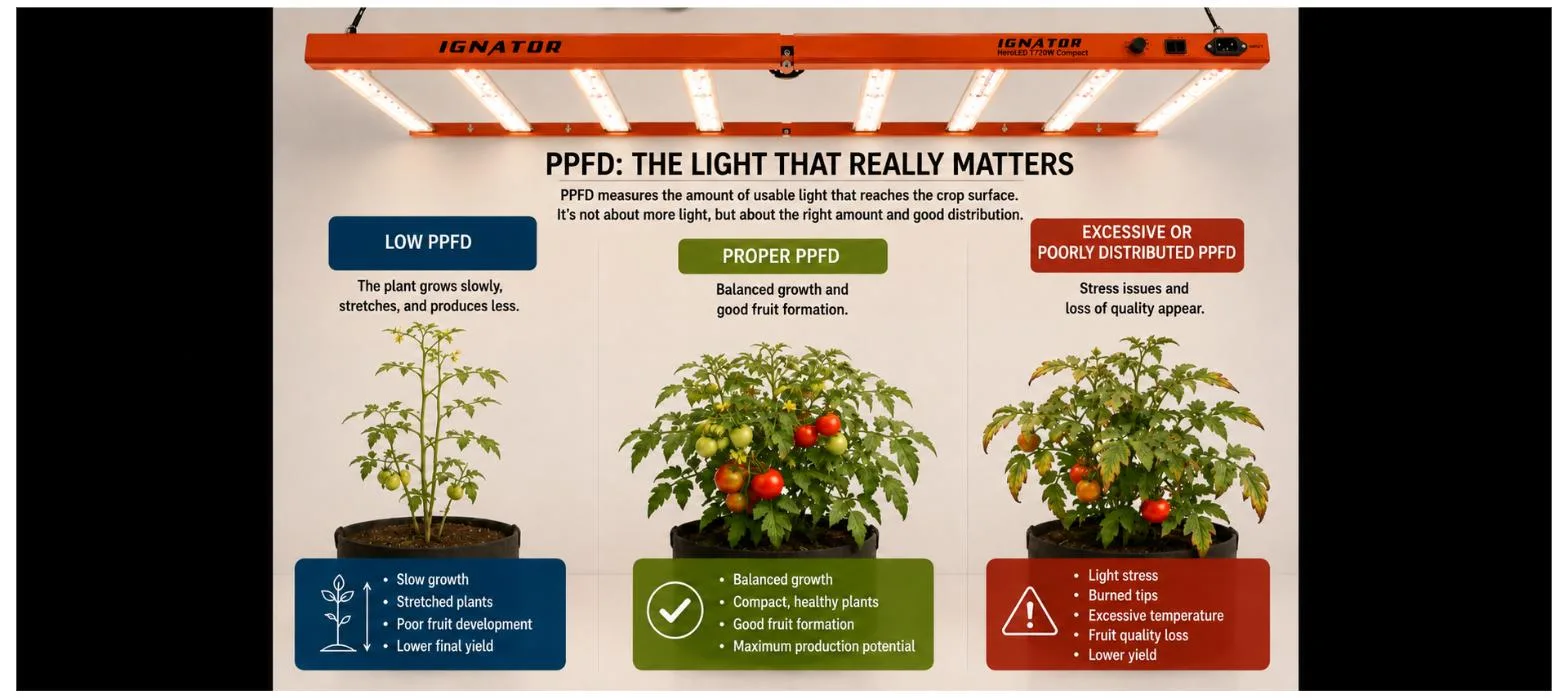
PPFD measures the amount of usable light that reaches a cultivation surface. Put simply, it indicates how much light energy the plant is actually receiving.
To understand it better:
- If PPFD is low: The plant grows slowly, becomes stretched (leggy), and yields less.
- If PPFD is adequate: You achieve balanced development and excellent flower formation.
- If PPFD is excessive or poorly distributed: Stress issues arise, and quality drops.
The most common mistake is assuming that more light is always better, when in reality, uniformity is what matters most. An poorly distributed excess of light can cause:
- Light stress.
- Bleached or burnt tips.
- Excessive heat.
- Loss of aroma and quality (terpene degradation).
- Uneven flowers.
The Most Common Issue: Hotspots in the Center and Weak Edges
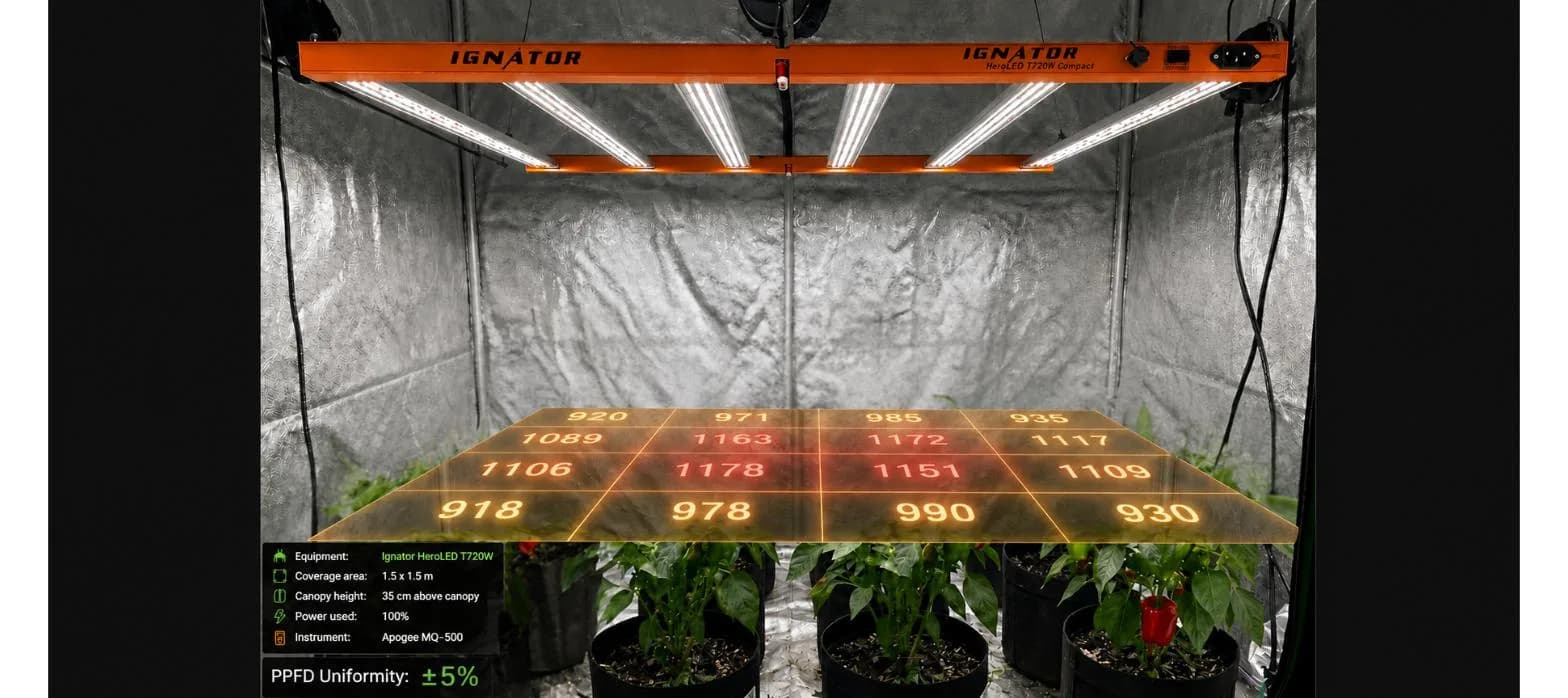
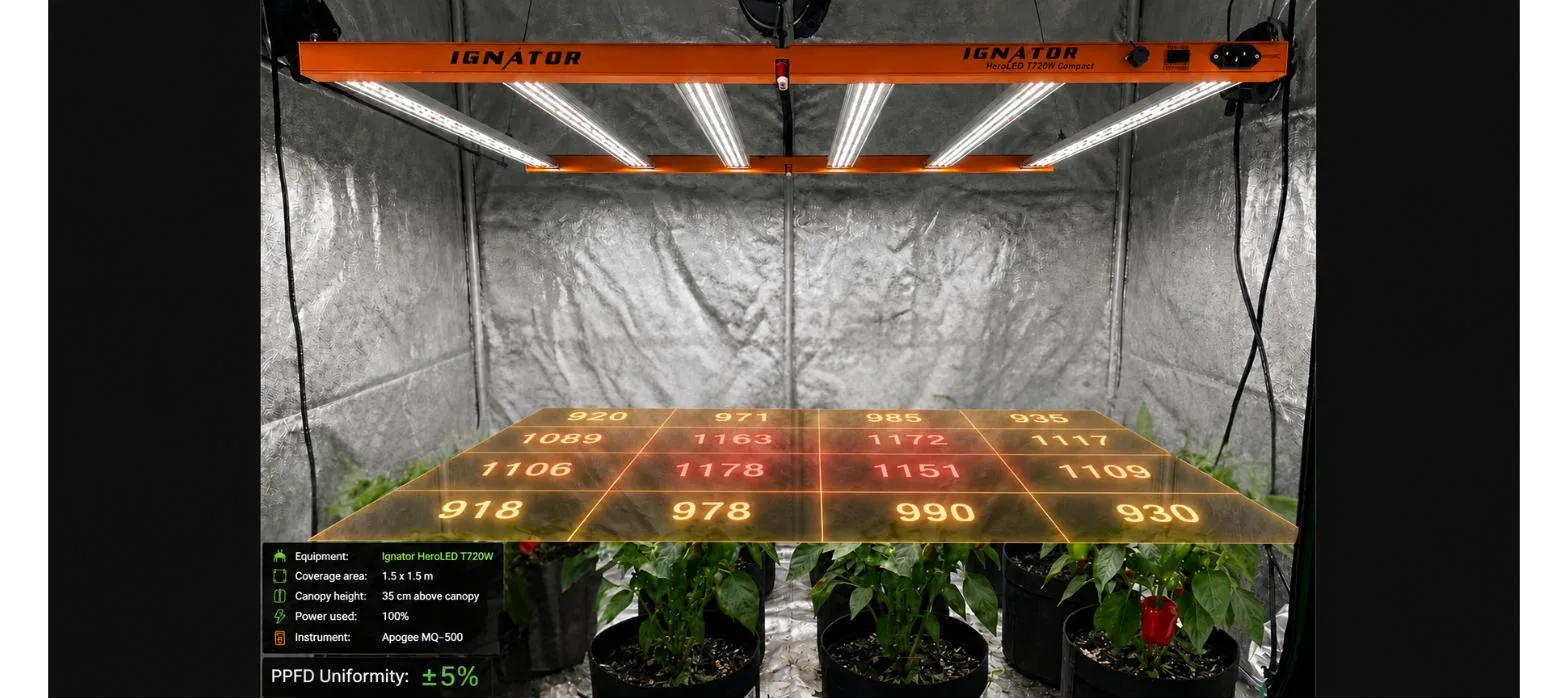
One of the most frequent flaws in LED lighting is a lack of uniformity. Plants in the center of the canopy often receive way too much intensity, while the edges and corners lag far behind. This creates a very noticeable development gap within the exact same space.
This happens because many traditional systems concentrate light directly underneath the fixture, creating notorious "hotspots." The result is easy to recognize:
- Highly stressed plants directly under the center.
- Side areas with lower production.
- Uneven growth across the room.
- Poor utilization of the available space.
And this isn't just an issue for small grow tents. In large commercial cultivation rooms utilizing dozens of fixtures, this effect multiplies and directly hurts the uniformity of the final harvest.
💡 The Multi-Bar Solution: This is precisely why multi-bar LED systems have revolutionized the industry. Fixtures like the Ignator HeroLED D720W or the Ignator HeroLED T720 Compact distribute light much more evenly, reducing hotspots and maximizing the total footprint of the space.
LED Efficiency: Producing More Without Raising the Power Bill
In the past, many indoor grows operated almost like giant space heaters, where a massive portion of the energy was lost as heat. Today, the goal is completely different: converting as much electricity as possible into usable light.
Luminous efficiency is measured in µmol/J. The higher this value, the better the fixture utilizes electricity. In practice, this translates to:
- Less heat generated in the grow room.
- Reduced workload for exhaust fans and simpler climate control.
- More stable temperatures.
- Lower overall energy consumption.
In the long run, this doesn't just improve plant health—it also significantly slashes operational and electricity costs.
How This Translates to Real-World Cultivation
When lighting is well-distributed and highly efficient, the results quickly become visible in plant development:
- More homogeneous growth across the entire room.
- Better flower density and compaction.
- Fewer differences between the top colas and lower canopy sites.
- Drastically reduced stretching.
- More uniform ripening and maturation.
Furthermore, the grow space is utilized much more efficiently, as there are no "weak zones" bringing down the overall crop yield.
Growth Stages and Light Requirements
A plant does not require the same light intensity throughout its entire life cycle, and understanding this is key to optimizing your results.
| Growth Stage | PPFD Range | Effect on the Plant | | :--- | :--- | :--- | | Seedling / Cutting | 100 - 300 PPFD | Highly sensitive phase. Prevents stress and promotes healthy root development. | | Vegetative Stage | 400 - 600 PPFD | Develops the main structure. Promotes more compact, robust, and resilient plants. | | Flowering Stage | 600 - 1000+ PPFD | Maximum light demand. Maximizes overall yield, bud density, and resin production. |
The Dimmer: A Vital Tool
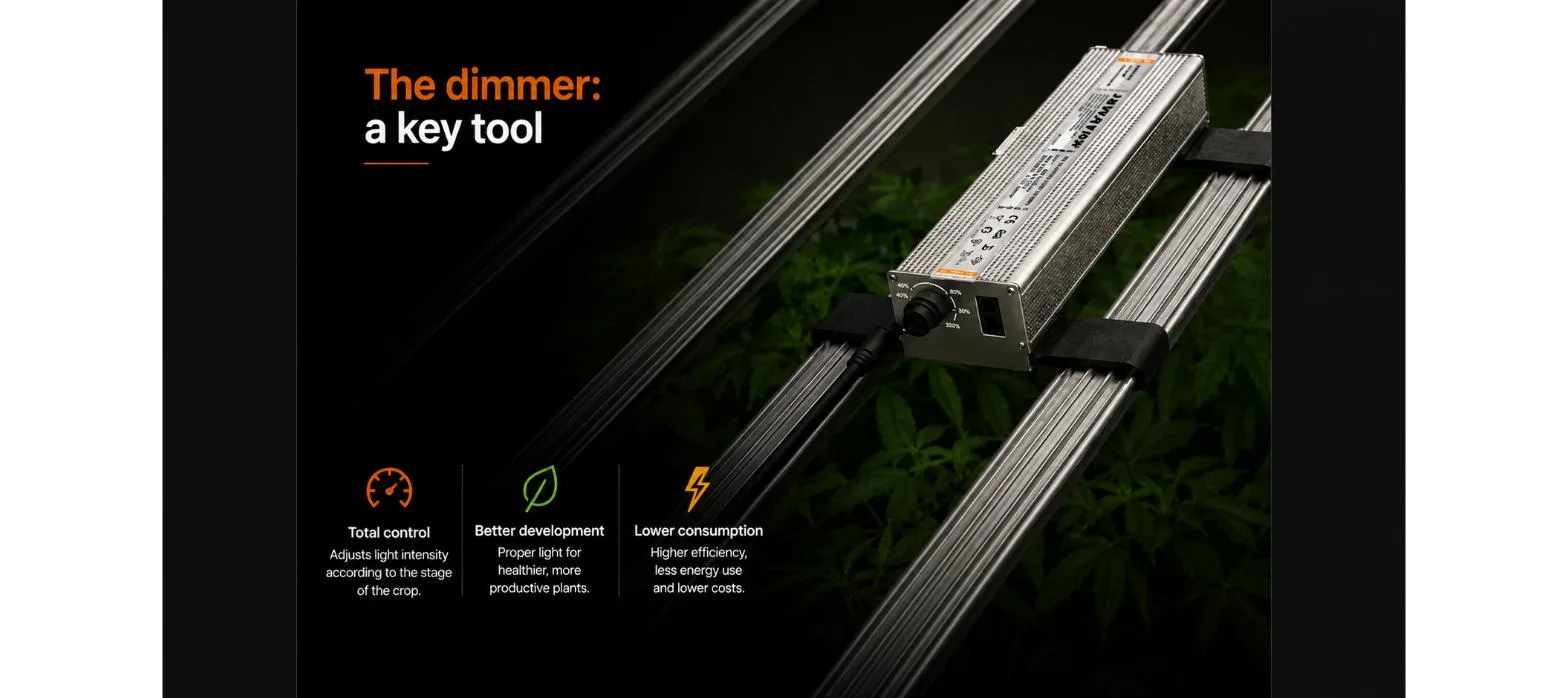
Intensity control is one of the most useful features of modern LED systems. It allows you to tailor the light to each specific stage of the plant's life, avoiding running at full power when it isn't necessary. This not only improves plant growth but also cuts down on electricity consumption.
In many cases, running your lights at 70-80% capacity during certain phases can actually be more efficient than blasting them at 100% constantly.
Small Details That Make a Huge Difference in Final Yield
There are minor factors that might seem secondary at first glance but have a tangible impact on the final outcome of your harvest:
- Keeping Fixtures Clean: Dust accumulation on LED bars blocks usable light from reaching your plants. Keeping your equipment clean ensures you maintain peak performance.
- Correct Installation Height: The distance between the fixture and the plant canopy directly dictates the PPFD. Hanging lights at the wrong height can drastically lower efficiency or trigger light bleach and stress.
- Dimming Control by Stage: You don't always need to run at 100%. Lowering the intensity slightly during veg or the first weeks of flower improves climate control and reduces unnecessary power usage.
- Adequate Airflow: Even though modern LEDs run much cooler, plants still require constant air exchange and movement across the canopy to stabilize temperature, humidity, and $CO_2$ levels.
- Electrical Stability: In large-scale rooms where multiple fixtures run simultaneously, power stability is crucial. Relying on high-quality controllers and robust connections prevents electrical issues and extends equipment lifespan.
Conclusion
Indoor cultivation has evolved toward a much more efficient model. Today, it is no longer about consuming more energy, but about making better use of it. Success relies heavily on three core pillars: efficiency, proper light distribution, and precise PPFD control.
This is why next-generation fixtures like the Ignator HeroLED D720W and Ignator HeroLED T720 Compact represent this new era of cultivation: bringing more balance, higher efficiency, and superior yields per square meter.
Because at the end of the day, in indoor growing, the winner isn't the one who burns the most electricity, but the one who best transforms light into a premium harvest.